
Reconstruct Jackson County Former Owners Transfer by Transfer
Start with the newest deed and work backward. Every row in a former-owner timeline should point to an indexed or recorded instrument, never just a sale line or a family story. That discipline matters. It keeps a skipped quitclaim, probate transfer, foreclosure deed, or replat from silently breaking the chain of owners.
| Transfer date | Grantor to grantee | Instrument | Reference |
|---|---|---|---|
| Newest first | Current seller to present grantee | Warranty, quitclaim, representative, or other deed | Instrument number or book/page |
| Prior step | That grantor's seller to that grantor | Earlier acquisition deed | Matching legal description |
| Repeat | Earlier grantor to earlier grantee | Recorded conveyance | Next index search term |
Note any difference in parcel coverage along the way. A single deed can convey several parcels or only part of a parent parcel, so a repeated surname alone never proves continuity of ownership.
Jackson County's Online Cutoff Needs a Caveat
The Register of Deeds advertises a grantor and grantee search covering deeds, mortgages, and miscellaneous records. The advertised window runs from 1964 back to 1800. An older county FAQ gives a different window, 1965 to the present. It also notes that advanced searches happen in the office. Do not quietly pick one figure. Treat 1964 versus 1965 as a coverage conflict. Ask the office directly what the active system exposes. The advertised legacy index capture preserves the endpoint tied to the 2026 platform transition. That shift makes the question of current coverage all the more worth asking.
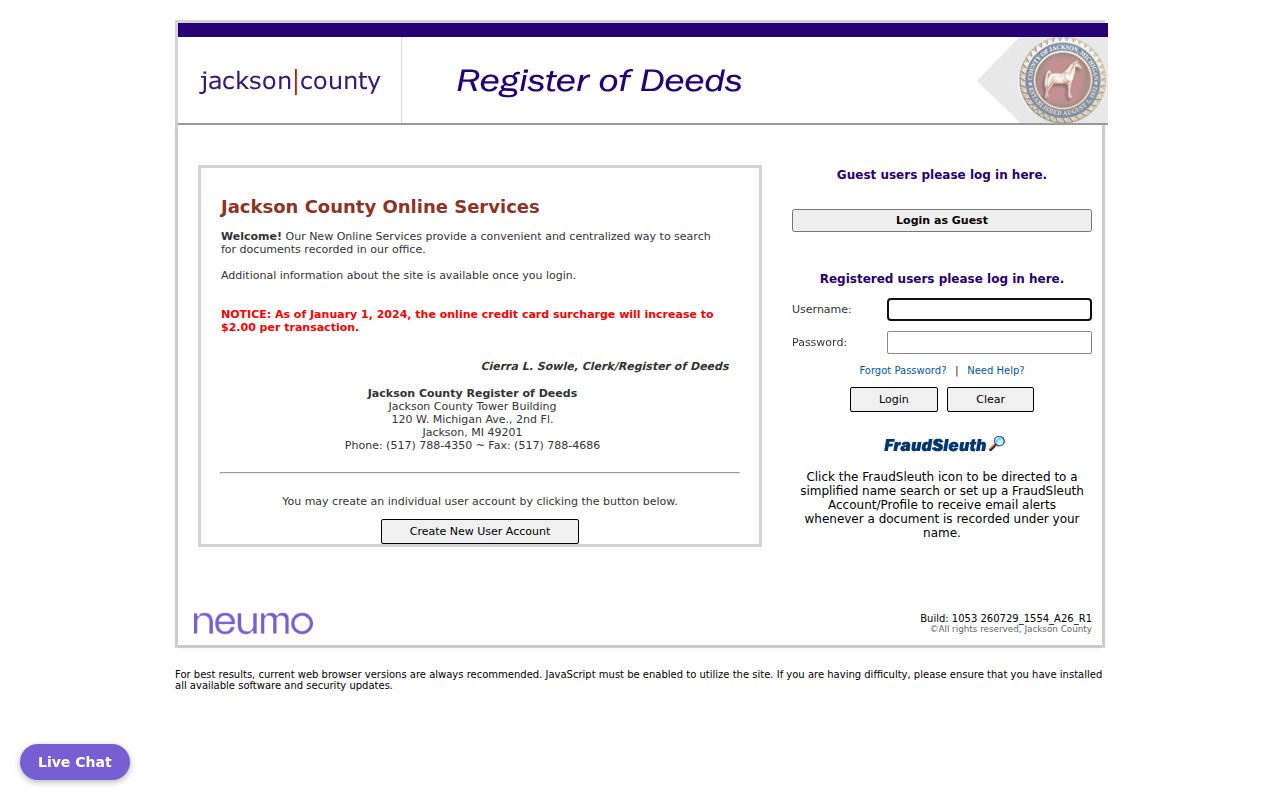
A legacy login page proves an old route failed. It cannot prove a former-owner record is missing. The 2026 transition itself matters too: local reporting described Fidlar AVID, Laredo, and Tapestry, while the legacy CountyFusion endpoint could fail. Save the platform name and search date beside every former-owner result.
Coverage limit. An online no-match does not prove that no earlier owner existed. Continue through the office index, tract books, deed volumes, archives, and other finding aids.
Walk Jackson County's Former-Owner Chain Backward
Begin with the current grantee's acquisition deed. Read the grantor's name. Then search that person or entity as a grantee in an older index range, repeating the step only when the legal description and instrument sequence support the same land.
- Find the latest conveyance tied to the exact parcel.
- Copy the grantor, grantee, date, deed type, and reference.
- Search the grantor as an earlier grantee, including name variants.
- Match lot and block, subdivision, section-town-range, or metes-and-bounds wording.
- Continue at the counter or in older volumes when the online trail ends.
A grantor gives an interest and a grantee receives it. A reverse index organizes entries by grantee, while a quitclaim conveys only whatever interest the grantor held, unlike a warranty deed with its stated covenants.
Use Jackson City Sale History as a Lead
The City of Jackson BS&A hub offers a Property Sale Search. It also hosts assessing and tax services. A sale row is a lead, not a deed image. It can suggest a likely date or party for an in-city parcel. It may also omit a non-sale transfer entirely. Use the date to narrow the Register of Deeds index. Then verify the parties and land description in the recorded deed itself. Outside the city, identify the local assessing jurisdiction first. Jackson County has 20 of them. Their historic fields need not share a single online depth.
Historic Jackson Plats Restore Old Search Language
A current Jackson address can sit inside recorded places with older names. Original Plat, Jacksonburgh, Morgan, Moore's, Ford's, Knapp's, Hemenway's, and similar additions appear in city planning material. Those terms are strong deed and plat search clues. Treat them as historic labels, though, not current neighborhood boundaries, unless the recorded plat says so. The Michigan subdivision-plat gateway notes that electronic submission and Accela searching began in 2019. Earlier plats remain firmly in county land-record territory. Lot and block language can reconnect an old deed to a current parcel after address or parcel-number changes.
Archives Extend Jackson County Previous Owners
The Archives of Michigan county guide lists Jackson assessment-roll series. Coverage runs 1844 through 1880, from 1900, and selected later years including 1920, 1940, and 1945 through 1975. Rolls give annual ownership and value clues. They are not deed substitutes. The Archives asks researchers to contact staff ahead, since county material may need preparation. Give the township, series, year, owner, and legal description. Ask whether the volume is original, microfilm, digital, or restricted. A missing year in a finding aid stays a collection gap. Staff must confirm an alternate series.
Note: Jackson County assessment rolls can bracket a change of owner, but only the related conveyance explains the legal transfer.
Atlas and Directory Clues Bridge Jackson Gaps
The Jackson County Genealogical Society holds land-owner atlases, plat maps, city directories, tax lists, family files, cemetery records, obituaries, and local histories. The Jackson District Library adds local-history and newspaper resources. Together they turn a historic resident or street clue into a township, plat, or owner name suited for deed searching. One strong route runs directory to atlas, atlas to assessment roll, roll to legal description, then description to deed. Keep every item labeled a finding aid. An instrument must confirm the transfer. The library's obituary keyword project covered newspapers from 1847 forward but paused in 2024, so a missing index result does not mean no newspaper notice exists.
Probate and Foreclosure Can Break a Clean Chain
Death can pull a previous owner out of a simple sale history. Look for an affidavit, death certificate, court order, or representative deed. Use the Jackson Probate Court route when an estate file is needed. Public MiCOURT results remain subject to exclusions. Tax foreclosure creates a second kind of break. The old tax-roll name marks one event. The foreclosure judgment marks a second one. The recorded disposition deed marks a third. Follow the Treasurer and deed evidence before deciding when a former owner's interest actually ended.
Measure How Far Jackson County Ownership Goes
Jackson County offers several layers for measuring how far ownership goes. Modern parcel IDs sit beside mid-century name searching. Older tract and deed indexes follow. Historic volumes, plats, assessment rolls, atlases, and directories round out the set. A 2026-27 county budget reports that tract-book scanning is complete. Legal-description searching reaches back to 1965. Historic tract-index uploads toward the 1800s were planned. Useful progress, though digitization remains uneven.
For every prior owner, record the source and date. Note the exact party spelling, deed type, and instrument or book and page. Add the legal description and the next search term. Stop where the evidence stops. The Jackson County deed records page details the full deed mechanics and copy channels.
Former-owner research suits house history, estate work, purchase diligence, and title questions. It must never serve to stalk, harass, or expose needless detail about a living person.
When the chain changes shape, test the land as well as the name. A parcel split may retire an old tax ID while the parent description continues in the deed books. A replat can swap one addition name for another. Marriage, probate, survivorship, and entity transfers can also alter the indexed party without any ordinary sale. Compare the grantor in one instrument with the grantee in the prior acquisition. Then confirm both describe the same land. If a year is missing online, contact the Register of Deeds with a known book, page, instrument, plat, or tract clue. For nineteenth-century gaps, treat township rolls, atlases, directories, probate calendars, and newspaper notices only as finding aids. Each clue should point back to a recorded conveyance. A chain holds only for the period its documents support, so note any break openly instead of assuming an owner. Record the last verified instrument and the next unresolved search term.