
Jackson County Property Tax Fields
Jackson County property tax records draw on more than one keeper. The local assessor sets each parcel's value and explains it. County Equalization reviews the rolls by class. Current bills rest with your city or township treasurer. Delinquent real-property tax moves to the County Treasurer. That handoff happens once the local cycle ends.
| Field | What it shows | Official source |
|---|---|---|
| Assessed value and SEV | The assessment and equalized figure for the year | Local assessor and assessment roll |
| Taxable value | The Michigan tax base after caps, additions, losses, and uncapping rules | Local parcel card |
| PRE or exemption | Whether a listed exemption affects the bill | Local assessor |
| Current bill | Levies, due dates, payments, and balance | City or township treasurer |
| Delinquent account | Transferred balance, interest, forfeiture, or foreclosure stage | Jackson County Treasurer |
A tax card is neither a deed nor a market appraisal. Quote any value with its year and local unit attached.
Jackson County Assessment Terms
Michigan assessment language is exact. State law places assessed value at 50 percent of true cash value. Jackson County Equalization checks local rolls against that level by class. It does not set each parcel's number. Proposal A created taxable value as a separate base. Its growth cap holds each year, subject to additions, losses, and uncapping on transfer.
- Assessed value
- The local assessor's value before county and state equalization adjustments.
- State equalized value
- The equalized figure intended to reflect half of true cash value.
- Taxable value
- The base to which tax levies apply after Michigan caps and adjustments.
- Mill
- One dollar of tax per thousand dollars of taxable value.
- Tax lien
- A legal claim securing unpaid real-property taxes.
A recent sale can uncap taxable value the next year. That quirk explains why two similar homes carry very different taxable values.
Find a Jackson County Tax Bill
Begin with the parcel number. It ties the map, the assessment, and the tax account together far better than an informal place name. Jackson County has 20 assessing jurisdictions. The city or township listed on the parcel record decides both the local assessment route and where the current bill is paid.
- Find the parcel in the county Tax Parcel Viewer and copy its exact ID and jurisdiction.
- Open the responsible local assessor or municipal portal and save the year, assessed value, SEV, taxable value, and PRE or exemption status.
- Check the local treasurer for the current summer and winter bills and payment entries.
- If the account passed the local deadline, use the County Treasurer tax pages for delinquent status.
- Record the retrieval date and ask the keeper for a payoff when a current amount is required.
A paid bill does not prove ownership. It records account activity for the parcel, not the full chain of title.
Jackson County Summer and Winter Taxes
The county's usual rhythm runs summer bills in July and a penalty point in September. Winter bills come in December. Unpaid real-property taxes transfer after February ends. Local dates and payment plans vary. The City of Jackson, for one, allows its summer bill through July 31. It also offers five installments ending November 20. The county posts cycle dates on its official current-tax-cycle page.
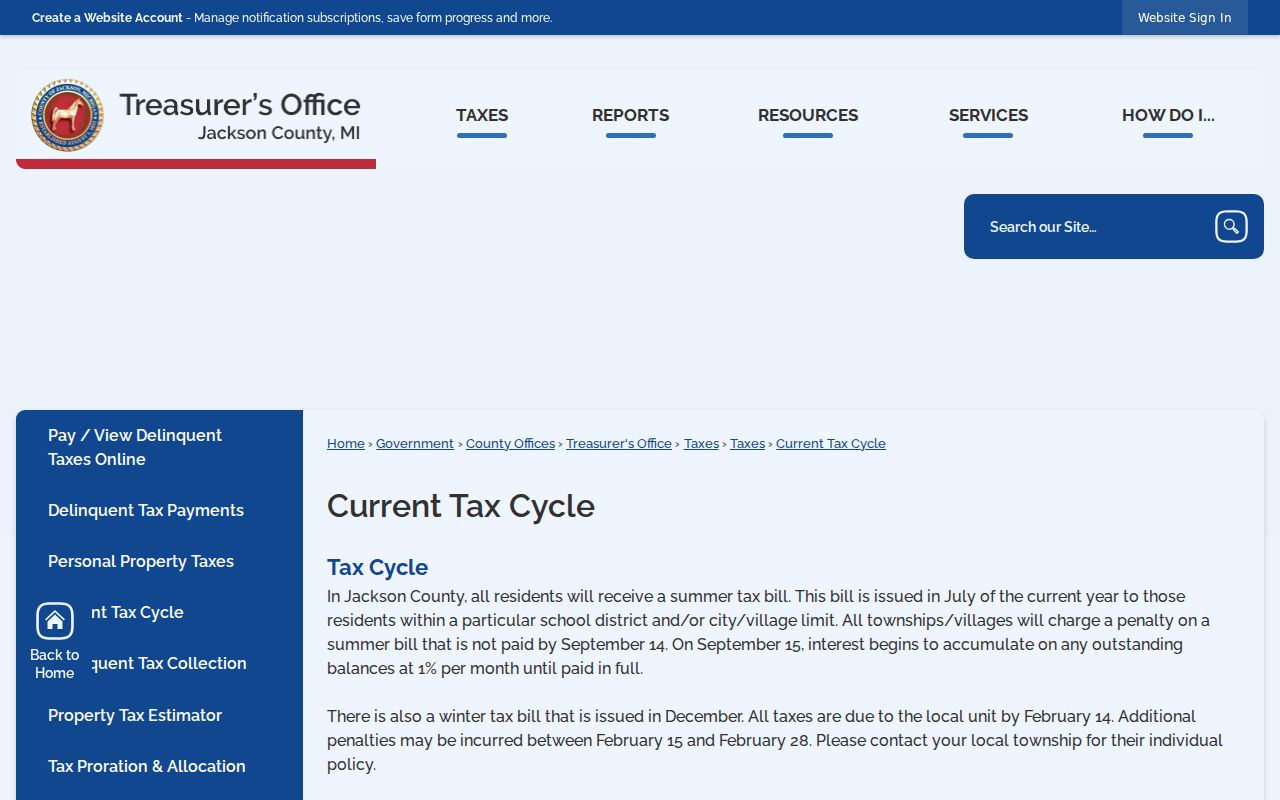
The calendar shows where the custodians split. Ask the local treasurer during the current cycle.
Note: Confirm the bill's local unit and year because City of Jackson timing can differ from a township schedule.
Jackson County Delinquent Tax Path
The County Treasurer lays out a Public Act 123 path of roughly 25 months. It runs from delinquency through forfeiture to foreclosure. County materials describe monthly interest after transfer. They also list a forfeiture fee, added costs, foreclosure, and a possible public sale. Not every late account reaches the final step. For one parcel, track the delinquent year and the payoff amount. Note the notice stage, any court or foreclosure reference, and any deed recorded later. The tax account documents debt and process. The deed index documents a completed conveyance. Keep the two straight. That habit stops an old tax-roll name from being read as the current owner of record.
Jackson County Property Tax Search Fields
The county viewer takes an address or a parcel and tax ID. Parcel details are exposed after selection. The City of Jackson BS&A hub accepts an address, a name, or a parcel number. Its tabs split Tax Search, Assessing, Property Sale, Special Assessment, and Detailed Record Search. Pick Tax Search for the bill and Assessing for values.
| Portal field | Input | Result to retain |
|---|---|---|
| County address | Situs street text | Parcel ID and jurisdiction |
| County parcel ID | Exact punctuation and zeros | INFO value and legal-description fields |
| City address | Street address | Matching tax or assessment account |
| City name | Owner label | Candidate parcels, checked one by one |
| City service | Tax, assessing, sale, or special assessment | The correct dated record class |
Outside the city, follow the parcel's municipality to the local assessor and treasurer. The city portal does not cover the whole county.
Jackson County Tax Exemption Records
Exemption and principal-residence information lives in the local assessment record. The City of Jackson assessor materials list PRE and exemption data among the parcel-card fields. Its property-tax exemption form requests the address, parcel, legal description, owner or organization, claimed statutory basis, use, occupants, funding, acquisition facts, signatures, and supporting deed or organizational records. The form sets a December 31 return point. It also warns that support may be reviewed. A filed form alone does not prove an exemption was granted. Check the final assessment roll or board decision for the year at issue.
Contest a Jackson County Assessment
An owner starts with the city or township assessor who made the parcel-level assessment. Ask for the current card and the land and improvement figures. Request the classification, transfer data, and any inspection or calculation records too. Then compare the same fields across the notice, the roll, and your evidence. Use the same year for each one. The State Tax Commission Board of Review page supplies forms, including petition L-4035. Each local unit sets its own meeting dates and filing steps.
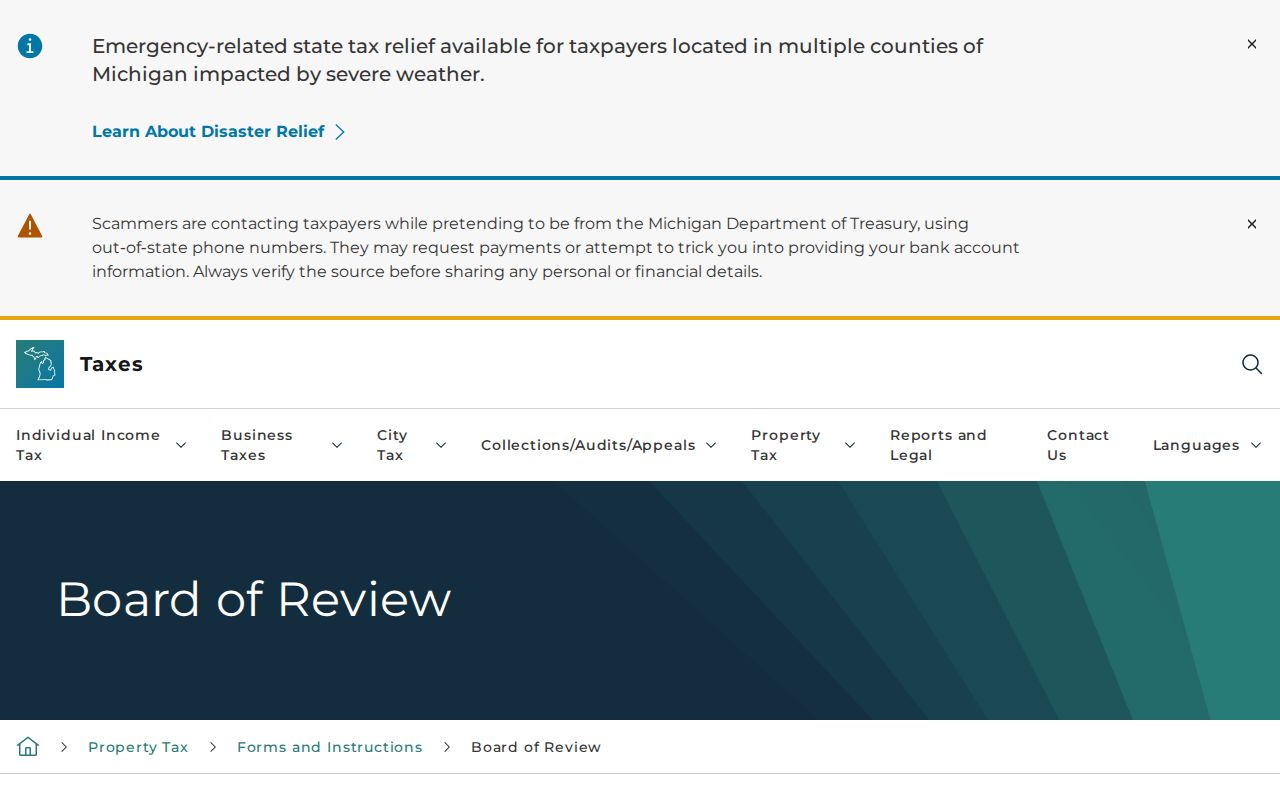
The state screen is only a form gateway. It fixes no Jackson city or township deadline.
Check the local appeal window. Obtain the current notice and Board of Review schedule from the responsible city or township before relying on a state form.
Jackson County Tax Record Limits
Jackson County property tax records answer some questions and not others. They do not prove clear title. They also fail to prove occupancy, an exact market price, building completion, or a surveyed boundary. What they do show is solid: assessed and taxable values, account charges, and exemptions on the roll. Payment status as of a stated date appears as well.
Treat each record as one tool with one job. Values need careful comparison across the assessed, SEV, taxable, and recorded sale fields. Keep those figures distinct rather than merged. Ownership calls for the latest conveyance. A permit or finished project belongs in the municipal building file. A boundary question needs the recorded plat, deed, and survey evidence.
Audit a Jackson County Tax Result
Check any Jackson County property tax result before you rely on it. Compare like years and like fields. Build one worksheet holding the assessment year, tax year, assessed value, SEV, taxable value, exemption status, the land and improvement split, and the local jurisdiction. Then flag every transfer, new construction, parcel split, combination, addition, or loss. Those events move taxable value apart from the ordinary market.
Keep the bill and the parcel card as separate records. A city tax payment screen can display a balance. But the assessor is the office that explains value and exemptions. County Equalization handles class-level studies, and the County Treasurer can supply a delinquent payoff figure. A portal can skip a historical year. Then ask the custodian for the roll or account record. Michigan FOIA covers identifiable nonexempt material that is not posted online.
- Exact parcel ID and jurisdiction
- Assessment and tax years
- Assessed, SEV, and taxable values
- PRE or exemption as displayed
- Payment or delinquency status and retrieval date
Jackson County Court Tax Evidence
A delinquent account can eventually reach court and deed records. The Treasurer timeline covers the administrative stage. MiCOURT offers a participating public case index. The Register of Deeds holds any recorded foreclosure or post-sale instrument. A docket entry reports case activity. It never replaces the signed order or the deed itself.
Search by case number when you have one. You can also search by named party and the selected Jackson court. Write down the court, case number, filed document, date, and disposition. Sealed or excluded material stays out of the public portal, and local image coverage varies. For a certified court record, request the file from the court clerk. A tax screen is not proof of a legal outcome.
Verify Jackson County Tax Payments
County materials list online, telephone, mail, and in-person channels for delinquent tax payments. Online or telephone work requires a parcel ID. A telephone credit-card payment carries a stated 3 percent convenience fee with a $2 minimum. Confirm the current payoff with the Treasurer, since interest and costs can shift the total.
Keep the payment confirmation, account year, parcel ID, and transaction date. A receipt proves a payment was submitted or posted. It settles nothing else. It will not decide an assessment dispute. It will not certify a boundary, clear every lien, or establish the current title holder. Those questions belong with the local assessor, the land records, or the court file.